Saturday, April 27, 2024

Meet the Deedles

Steve Boyum, 1998
Rotten Tomatoes score: 10%

This is a movie that no one on the planet earth other than me seems to remember. Even I had only the vaguest possible recollection until I found it available for streaming this morning and decided to refresh my memory.

Meet the Deedles is the most X-treme movie of all time. It's like a 90-minute Mountain Dew commercial. Phil (the late Paul Walker) and Stew (Steve van Wormer) Deedle are two totally righteous teenage superdudes from Hawaii who are so tubular that within the first five minutes they've been arrested by a jet-ski-riding truant officer while parasailing on a school day.

Their grim, wealthy father is so disappointed in them that he ships them off to Jackson Hole, Wyoming, to work for a month in a juvenile work camp. But the camp turns out not to exist, and instead it's just a psychotic mountain man who drives at high speed through the woods, crashes his truck, and sends the Deedles comically flying into the air and through the campsite of two female National Park Service recruits named Mel and Mo.

The Deedles, unaccustomed as they are to the cool mountain weather, change into the nearest available sweatsuits, which belong to Mel and Mo and conveniently have their first names written inside the collars. Then they take off on a high-speed skateboard escape down the highway, where they accidentally free a bunch of circus animals to keep Mel and Mo busy while the Deedles are knocked unconscious and identified at the Yellowstone hospital (by the names written inside their sweatshirts) as Mel and Mo. So at this point we realize that this has all been an absurdly elaborate set-up for the Deedles to be mistaken by the authorities for the new junior rangers.

Fortunately, all the blustering ranger captain (John Ashton) knows about his new hires are their first names and that they are outdoor survival experts. So he forces them to eat bugs for dinner and assigns them to stop an ongoing invasion of prairie dogs that threatens to disrupt the festivities during the one-billionth-birthday celebration for Old Faithful.

This is the plot of the film.

It turns out the prairie dogs have been introduced into the park deliberately by Dennis Hopper, a former ranger who lost his badge and wants revenge. It also turns out that Stew Deedle is a computer hacker—how could he not be?—and I guess he hacks into the prairie dog colony or something. I'm starting to lose the thread.

Meanwhile, Phil Deedle has fallen in love with the irascible captain's second-in-command and step-daughter, Jessie. Also meanwhile, Mel and Mo, the real outdoor survival experts, are putting their skills to the test while avoiding the escaped circuis animals.

Again, this is the plot of the actual film. I did not make up or imagine any of this.

Dennis Hopper sends two bumbling idiots, one of whom is played by Freddie Krueger, to kill the Deedles, but they fail in cartoonish ways because they're stupid. Unfortunately, the real Mel and Mo eventually make their way to the park and spoil the Deedles' scam. Then, while the captain is berating them aboard a helicopter, the bad guys somehow cause him to fall into the river in an appallingly bad blue-screen shot.

The Deedles perform a surf-and-rescue mission, and Jessie, who turns out to be a professional stunt helicopter pilot, airlifts them to safety. Having won over the captain by their heroics, the Deedles get a second chance to win their ranger badges. I guess now they want to be actual rangers. They also throw a luau, which Stew describes as a "Don Hoedown" because the Yellowstone people apparently don't know what a luau is. I hadn't mentioned it before, but the dialogue in this movie consists almost entirely of winking, ironically stupid quips like that.

The hacker Deedle deploys his plan to drive the prairie dogs out of the park using mentholated arthritis cream, but Dennis Hopper sabotages it by causing Old Faithful to explode. Stew immediately suspects sabotage—a theory that Phil at first dismisses as "so diculous it's re-diculous"—but Stew proves it using a computerized map readout with blinking dots.

In Dennis Hopper's evil underground lair, the Deedles learn the true depth of his sinister plan: to divert the high-pressure water away from Old Faithful into a new geyser called New Faithful, which will be the highlight of his own, competing national park. Fortunately they are able to outwit his dimwitted henchmen and redirect the geyser to its original location just in time to save the birthday celebration.

Then it turns out that the geyser has been supercharged, creating a giant crater lake with surfable waves in the middle of Yellowstone, which the Deedles' grim, wealthy father names Deedlestone. I think this is basically the same thing that Dennis Hopper was planning to do, so in retrospect maybe his sinister plan wasn't so bad. But he has now been arrested for blowing up Old Faithful and trying to kill people, I guess, so let's forget about him.


Looking back, I'm not sure I've ever actually seen this movie before. I know I saw part of it on the Disney Channel or something, or maybe on VHS, but 90% of it did not ring any bells. It's much, much, much better than I remembered. I've done my best here, but I don't think I'm doing it justice.

Friday, September 23, 2022

Big Bully

Steve Miner, 1996
Rotten Tomatoes score: 0%

This is a rare accomplishment, a theatrically released major-studio motion picture that has a 0% approval rating on Rotten Tomatoes. I knew before I watched it that it was a flop, but I wasn't aware it was quite that universally despised. For the first four fifths of the movie, I would have been surprised by that, but the ending is so awful that it's hard to disagree with the critics. Not to mention the audience—this movie only earned back 13% of its modest budget at the box office.

But I'm getting ahead of myself. I'll come back to the rating after I discuss the plot in excessive detail.

Rick Moranis plays David Leary, a published but seemingly unsuccessful novelist who grew up as a bullied youngster in a small midwestern town. His tormentor was Ross Bigger, one of those big, mean, superhumanly strong fat kids who seemed to be lurking around every corner in the early 70s. David eventually got his comeuppance against Ross by ratting him out for stealing a moon rock from a museum. David's family then moved to California while Ross did time in reform school and grew up to be a meek, depressive loser.

Many years later, David receives a letter from his old middle-school principal, who for no logical reason offers him a job as an English teacher back in Minnesota, so David and his troublemaking son pack up and move back east.

For a few mindless scenes, David integrates himself back into his old social circle—every other person he knew as a kid has never left town, and they're all still friends—but things begin to go bad when Ross, who now works for peanuts as the school shop teacher, recognizes the old nemesis who sent him to the big house and plots revenge. His revenge really just amounts to playing some childish pranks and trying to prevent David from getting back together with his old sweetheart Victoria.

But Ross is so excited to have his archenemy back that he undergoes a major personality change, becoming a big bully in all walks of his life. He lays down the law with his misbehaving kids and spices up his marriage by throwing his TV set into a lake (which his wife Carol Kane finds very attractive for some reason). He even imposes order on the delinquents in his shop class by threatening to murder one of them. David's fear of Ross causes him to behave increasingly strangely, which leads Principal Don Knotts to threaten to fire him if he doesn't get his act together. So David decides to have a heart-to-heart conversation with Ross, where he confesses that he was the one who dropped the dime on the moon-rock caper all those years ago.

But wait, you may say. If Ross didn't know that David was the one who snitched on him, why did he want revenge to begin with? I have no idea, but now that he knows, he and David get into a fight to the death in the shop room. Their brawl spills out of the school and into the nearby woods where they used to fight as kids. They have a final dramatic confrontation that results in Ross falling to his apparent death into a river.

David plans to turn himself in to the police for manslaughter, but first he confesses to an old friend who promises to help him cover up the evidence. At home, David speaks to his wacky neighbor Jeffrey Tambor, who somehow knows exactly what David has done and confesses that he too has occasionally contemplated homicide. This scene is so absurd that I was almost certain it would turn out to be a dream. But it isn't. Instead, Ross returns from the woods completely unharmed, and he and David momentarily resume fighting before abruptly deciding to bury the hatchet.

In the next and final scene, David and his son are moving away from Minnesota to New York, where Victoria (the love interest who played a completely insignificant role in the film and was last seen rejecting David because of his paranoid behavior) promises to join them soon. Little do they realize, Ross and his family have decided to move to New York too, so they can be best buddies forever.

And that is the end of the movie.


I have a hard time calling this one as either underrated or not. At no point is it a good movie, but for the first two and a half acts it's no better or worse than any other randomly selected goofy family comedy from its time. But as soon as David and Big Bully start fighting each other, it swerves wildly off course and becomes a surreal, subversive dark comedy. And then in the last five minutes it just collapses completely.

The basic premise here of a misfit kid who grows up and is suddenly reunited with his childhood bully has obvious potential for a comedy. It could work well as a kids' movie or as a dark comedy, but instead they sort of split the difference, and the result is weird and jarring. I can't recommend it, but I guess I can recommend watching the first 70 minutes or so and then turning it off. Anyway, it's bad, but I'm still impressed that not a single person gave it a good review.

Friday, December 24, 2021

Johnson Family Christmas Dinner

(NOTE: None of the people in this picture are in the movie.)

Eurika Pratts, 2008
IMDb score: 2.4/10

Here is another obscure and mysterious Christmas film that will leave you deeply confused. You'll notice that it has a very low score on IMDb, yet it blows yesterday's feature, Rapsittie Street Kids, out of the water, and rightly so.

This movie was made by BlackChristianMovies.com and seems to be a sequel to their other film, Johnson Family Dinner—or possibly vice-versa. I haven't watched Johnson Family Dinner, but I'm guessing that it came first. I found it on YouTube and watched the first 30 seconds, but life is just too short.

The real excitement of watching Johnson Family Christmas Dinner is trying to figure out how all of these characters are related to each other. The movie makes no effort to explain any of the relationships, maybe because it's a sequel and assumes familiarity with the first film. The Johnson paterfamilias is Stephen, who appears to be in his early 40s but who has children who are the same age as him. Stephen has several children, including Theresa and Sam, who arrive in a car together, along with a small child named Chrissy, at the start of the movie.

This made Theresa and Sam appear to be married, and that impression is reinforced when Theresa addresses an older woman—who I took to be Stephen's wife—as "Mother Johnson," which sounds like something you'd call your mother-in-law. But don't be distracted: Theresa is Sam's sister, not his wife. Stephen tells us this moments later when he asks Theresa, in obvious reference to Sam, "How was your brother's driving?"

So why did Theresa call the older lady "Mother Johnson"? I have no idea. To the best I can figure, Mother Johnson (whose name may or may not be Bonnie) is Stephen's sister. The movie will try to confuse you about this—for example, a character will later refer to Stephen and Mother Johnson as "your grandparents" when speaking to Stephen's granddaughter—but don't let yourself be fooled. Stephen will soon make an offhand comment to Sam that Sam's mother is dead and that he (Stephen) lives alone. So Mother Johnson has to be his visiting sister. Now, why would Theresa call her aunt "Mother Johnson", you ask? I don't have all the answers.

Theresa seems to have three children: young Chrissy, who we've already met, teenager James, and college student Cindy. James, we're told, is catching a ride from his friend Reggie and will arrive soon. But earlier we learned that Theresa read a book and Cindy took a nap while Sam was driving to the house, so I was under the impression that they had driven at least a couple of hours. Yet Reggie will never appear in the movie, which means he dropped James off and left. So did Reggie drive hours to drop his friend off at this place?

Cindy shows up a few minutes later with her boyfriend, who calls himself the Eagle. The Eagle is a weirdo who eats nothing but raw tomatoes, claims to sleep standing up (like a horse), and aspires to make ridiculous-sounding movies. Stephen, that rock-ribbed family man, finds the Eagle off-putting and discourages Cindy from her plan to move in with him during grad school.

Another family member is Michelle, who is definitely Stephen's daughter, Theresa and Sam's sister, and the children's aunt. (They helpfully address her as "Aunt Michelle", which is not intended as a blind. She is really their aunt. I'm certain of it.) Michelle's only problem in life is that she can't manage to settle down with any of the men she's been dating, even though some of them have Blu-Ray players.

That detail about the Blu-Ray player might sound like a joke, but it's not. Little Chrissy is obsessed with getting a Blu-Ray player for Christmas—remember this is 2008—and has been grilling every family member about it. It is in that context that Aunt Michelle relates her experience with Blu-Ray-player-owning suitors.

Stick with me. This is all crucial plot information.

Meanwhile, we occasionally cut to a side plot about another family member named Moneymaker Mike.

No, sorry. That's not him. I regret the error.

His name is really Money Mike, and he has a girlfriend who appears in the credits as "Shane mm's GF". Money Mike and Shane are on their way to Stephen's house for Christmas dinner, but they never actually make it there. They eventually have a breakdown or possibly run out of gas. No one else in the family ever seems to notice they're missing. Mike blames the car trouble on an "Arab dude who made his own oil" and sold it to them. I have no comment.

At some point, a young man named Robert appears at the Johnson house. Robert is clearly Mother Johnson's (Bonnie's?) son. Because I was still making the incorrect assumption that Mother Johnson and Stephen were married, I deduced from this fact that Robert is the brother of Sam and Theresa, but he's not. He's their cousin, I think, but that's based on my current belief that Mother Johnson is Stephen's sister, and I still have some residual doubts about that.

Robert is estranged from his wife, Hillary, who appeared in the first 30 seconds of Johnson Family Dinner and seemed to be a main character. And he has a drinking problem, by which I mean that he has trouble drinking: in one scene, he lifts a wine glass to his mouth but doesn't manage to get anything out of it.

(He also has a drinking problem in the more conventional sense.)

Speaking of intoxicating substances, it turns out that James has brought along a couple of joints and plans to blaze up in grandpa's guest bathroom. But he has to call his school chum Reggie for advice on how to smoke them, implying that he's never used grass before. So he decided to try marijuana for the first time while visiting his conservative, straightlaced grandfather on Christmas Eve, surrounded by family members? Well, at least he had the sense to light up next to a window. It would have been smarter to open the window first, but he's new at this.

All right, so you can see that the family members all have their own problems. And those problems boil over at the dinner table, right after the family finish eating a hearty meal of yogurt and a box of spring mix from the Kroger. Everyone starts yelling until Stephen declares that dinner is over and everyone should just go to bed.

We then see all the actors pretending to sleep in what appears to be broad daylight. (It's not even the bad day-for-night look you sometimes see in low-budget movies. It's just day. Maybe it's morning already. I don't know.) Oh, and true to his word, the Eagle sleeps standing up, with his arms folded over his chest like Boris Karloff in The Mummy.

In the morning, everyone instantly reconciles with each other, and everything is fine. End of movie.


I really don't think I'm selling this movie well enough. It is a joy to watch. The challenge of making sense of the character relationships is the most engaging movie-watching experience I've had in a long time. I'm convinced that there are some places where the dialogue outright contradicts itself about who is related to whom and how. It's like solving a jigsaw puzzle with an unknown number of pieces from a different puzzle thrown in.

I was curious about the negative IMDb reviews this thing got, but I was disappointed to find only one written review in addition to many one-star ratings by users who didn't include written comments. Everything the one reviewer says is true, but I have the feeling that "zardoz12" had the wrong attitude going in. But, while I was looking for reviews, I found the IMDb plot summary, which differs quite a bit from what I thought the plot was:

This comedy drama focuses on the trials and tribulations that a family goes through, always reconnecting over Sunday, possibly Christmas, dinner. As a mother and father observe the unfortunate events of their grown children's lives, they have to pick when and where to become involved. From Alex, who opened a failed restaurant with her husband Sam, to Robert Downy Jr. who's just welcomed a new baby into the world, to Rebecca, who suffers from a seasonal irritable bowel syndrome, the dinner table sees its share of laughter and tears, but over time each family member learns that they depend on each other to get through it - even when they're in each other's throats.

I remember the family being "in each other's throats", but I don't recall anyone named Rebecca or any character having irritable bowel syndrome—at least not that was mentioned. And what is this skepticism about whether it was Christmas dinner? That seemed pretty clear.

And how did I miss Robert Downey Jr.'s appearance? I guess this was during that slump in his career between Chaplin and Iron Man.

Well, I've said quite enough about Johnson Family Christmas Dinner. I can't recommend it enough. It's on YouTube. Watch it before the holiday season is over.

Thursday, December 23, 2021

Rapsittie Street Kids: Believe in Santa

Colin Slater, 2002
IMDb rating: 1.3/10

This bizarre "movie" was made in 2002 and apparently aired on a large number of local WB stations—though not on the national network, contrary to rumor—only to be forgotten for many years before being uploaded to YouTube. It has become somewhat notorious for it's appallingly bad animation and incomprehensible plot. But the really shocking thing is that the cast includes some first-rate voice actors like Nancy Cartwright from The Simpsons and even Mark Hamill (who, in addition to playing an elderly hobo in a recent series of flop space comedies, is a highly respected voice actor).

Bad animated Christmas movies are a dime a dozen, but this one sets its own standard. The computer animation in The Christmas Brigade was clunky and primitive, but this movie is grotesque. The characters have a hideous, uncanny appearance, and the backgrounds look like they were animated by a small child on a home computer running Windows 2000. It's abhorrent. It's disturbing to look at—especially the character Smithy, who has a scarf wrapped around most of his face all the time, so all you can see are his enormous, lifeless eyes.

The main character, whose name I believe was Ricky, looks only slightly better. His scalp is often visible between chunks of hair, giving the impression of a bad wig, or maybe the early stages of radiation poisoning. In the opening scene he walks, like a clumsy windup toy, through a field of snow without leaving footprints and without ever seeming to be physically in the same place as the rest of the scene. But the most important character by far is Ricky's great-grandmother:

The comments on that YouTube video contain various speculations about why great-grandma talks like that. One commenter claims that the voice data was corrupted, and they didn't bother to fix it. Another says that it's really the actress speaking, which is definitely not true. Well, you're not going to find the solution here. I certainly can't explain it. I'm pretty confident it was the result of incompetence rather than a deliberate choice, but who knows.

The plot of the film is that Ricky wants to give his classmate Nicole, who he fancies, a teddy bear that he received years earlier as a gift from his now-deceased mother. That's pretty weird, but let's not dwell on it. Nicole is a rich (?) snob who only likes gifts that were purchased at the mall, so she rejects the teddy bear. Ricky and Smithy then have to look through some garbage dumpsters to find it.

I know I'm not getting this exactly right, but I had some trouble understanding the plot, and I refuse to watch it again. It's very bad.

I think there were some songs.

I really don't know what else to say about this. It's on YouTube if you want to see it for yourself. If you watch to the end, you'll see that they tease an Easter-themed sequel, and it's almost heartbreaking that they thought that was going to happen. I don't know how you could watch this movie and think it might be worth making another one. Then again, it bears repeating that someone deemed this acceptable to show on television, so who's to say it didn't deserve a sequel.

Thursday, November 25, 2021

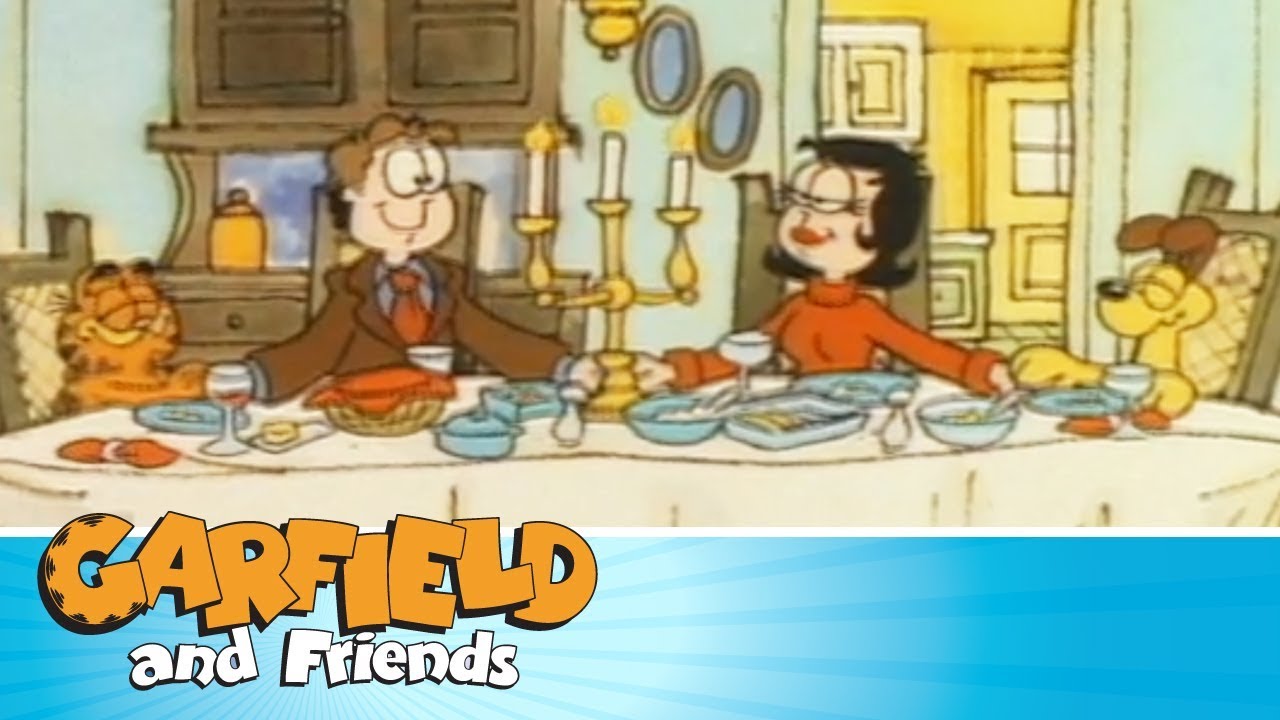
Garfield's Thanksgiving

Phil Roman, 1989
IMDb rating: 7.9/10

I got a couple of things wrong about this in my offhand less-than-one-sentence reference to it at the end of my review of Dutch. I said it featured "old Garfield and Doc Boy", but Jon Arbuckle's brother Doc Boy does not appear in it. I must have been thinking of the Garfield Christmas episode. I also implied that it was made in 1991, but it was 1989.

In my defense, I can't ever remember seeing this before, even though I was an avid fan of the Garfield and Friends cartoon, which I recommend. Garfield's Thanksgiving is not really a movie. It's what people commonly call a "TV special", but usually that means a feature-length (or close to feature-length) production. In this case it's just a half-hour episode of Garfield and Friends, but it's devoted to a single story rather than being broken up into smaller segments.

I'm describing this at length because there's not a lot to say about Garfield's Thanksgiving adventure. The plot is that Garfield has to go to the vet's office the day before Thanksgiving, and she puts him on a diet. Meanwhile, Jon is engaged in shockingly desperate and self-destructive behavior to get the veterinarian, Dr. Liz Wilson, to go on a date with him. He gets her to come over for Thanksgiving dinner by holding his breath until she agrees—which is what a three-year-old would do. I know Jon Arbuckle is not noted as a ladies' man, but this is profoundly pathological behavior.

Are we supposed to believe that Liz Wilson had no plans for Thanksgiving? Or did she have to call her family and explain why she couldn't visit them this year because a pathetic manchild who talks to his cat held himself hostage until she promised to eat dinner with him?

Garfield's diet occupies about three minutes of plot time. Liz insists that Garfield cut down on carbohydrates and fat, so Jon feeds him half a lettuce leaf for lunch. That seems pretty inadequate, especially since cats are carnivorous. Anyway, as soon as Liz shows up at the house, she decides to cut Garfield some slack on the diet, and that's the resolution of that.

Meanwhile, Jon reveals that he somehow has no idea how to prepare a meal, even though he's a bachelor and presumably manages to feed himself on a regular basis. Well, I guess it doesn't take Wolfgang Puck to whip up the gigantic, plate-sized, completely raw steaks he usually eats:

So he botches the job by leaving the turkey frozen solid until Thanksgiving morning, and then he puts a bunch of raw, uncut vegetables into a pot and pours water on them and thinks that will be edible. Finally Garfield convinces him to call his grandmother in to save the day. I appreciate that they actually thought through the question of how anyone could possibly salvage a frozen turkey, which grandma does by slicing it into slabs with a chainsaw and then deep-frying. (Wouldn't there be pieces of bones in all the slices? Oh, who cares.)

While this is going on, Jon is distracting Liz by telling a series of boring stories about the history of Thanksgiving and how it compares to similar harvest-time festivals in other countries. I got the impression that Jon was just buying time so Liz wouldn't realize that he had called his elderly grandmother to make dinner for him and his date even though he's a grown man with a house and a job. But, if this is just a distraction, why does Jon just happen to know all of these pointless facts? Is it possible that there's a hole in this plot? Maybe I should watch it again.

Whatever the case, the dinner turns out great, and Liz never finds out that Jon's grandma made it. She just walks into the dining room and sees that the table has been miraculously set and doesn't ask how it happened. Maybe she figures Odie did it. She's so pleased with the food that she promises to come back next Thanksgiving and kisses Jon on her way out the door.

He is so in there. Maybe this holding your breath until you pass out trick isn't so bad after all. I'll go practice.

Wednesday, November 24, 2021

Dutch

Peter Faiman, 1991
Rotten Tomatoes score: 14%

In 1987, John Hughes made one of the best movies in the world. Planes, Trains and Automobiles is not just a solid comedic film, though it is that. It's one of those few movies that really stays with you and makes you feel good about life.

Steve Martin and John Candy portray two flawed, believable, relatable strangers stuck together on a Thanksgiving weekend trip that goes wrong in every way a screenwriter can think of. Of course, there's nothing brilliant in that concept; it's been done a million times. It's the execution that made the movie such a classic, from Del Griffith's pantomime of the "Mess Around", to the at first funny but then increasingly heartbreaking confrontation in the motel room ("You want to hurt me?"), to Edie McClurg's two-word response to Steve Martin's over-the-top outburst (the scene that singlehandedly got the movie its R rating), to the weird but hauntingly evocative synthesizer score, to the very last shot of the movie, where John Candy says more with a facial expression that most movies manage to say in 120 minutes of dialogue. The film accomplishes such brilliance with such a humdrum concept that one can't resist the temptation to compare it to "a lesser film". A lesser film would have made this story stupid, or sappy, or irritating, or all three.


"And just to prove it," said John Hughes in 1991, "by God, I'll make that lesser film!"

To be fair, John Hughes only wrote Dutch. Other people directed and produced it. But I can't let him off the hook that easily. Hughes had a massive influence on the pop culture of the 1980s and 90s, and his movies were scattered broadly across the comedy spectrum, both in terms of content and of quality. (Consider that The Breakfast Club and Flubber were written by the same man.) And I know it's not fair to put him up on a pedestal just because he made one of my favorite movies. But the similarity of this film to Planes, Trains is so blatant that it cries out to be judged by its predecessor's standard.

The effect is like watching Jaws 2 after you've seen Jaws. It's not bad exactly, and if the first Jaws had never existed, Jaws 2 would have been just another OK summer movie. But, because it was a sequel, it became an exercise in recreating every commercially successful aspect of the first film, only without the coherence and plot integrity that made the original work so well. It's a mediocre movie doing an impression of a really good movie.

So is Dutch.

Dutch Dooley (Ed O'Neill) is a working-class Joe whose girlfriend Natalie was the loser in a painful divorce from her rich snob husband Reed (perennial bad guy Christopher McDonald). Reed is a jerk. He has no other personality traits, except that he is a rich jerk. His richness is important because it distinguishes him from Dutch, who is also a jerk, and because it gives us an ostensible reason to consider Dutch an underdog and therefore worthy of our sympathy.

Natalie learns that Reed, who was supposed to spend Thanksgiving with their preteen son Doyle, has stood the boy up for a business trip. Doyle, whose spoiled mind has been poisoned by Reed, would rather spend Thanksgiving alone in his dorm room at boarding school than with his mother, but Dutch offers to prove his worthiness as a mate by bringing the little bastard home to Chicago for the weekend.

Dutch and Doyle's relationship strikes the worst possible note right off the bat. Doyle knows who Dutch is and why he has come, but he pretends to think he's an intruder and tries to beat him up using his karate skills. The scene is played too seriously to be slapstick, and it makes the kid seem deeply disturbed. Dutch then responds by hog-tying the boy to a hockey stick and carrying him bodily out to the car.

In the right kind of movie, this could have been funny. When Bad Santa beat the crap out of some teenage bullies, it worked, because you knew that was the kind of movie where it's OK to laugh at Billy Bob Thornton beating up children. This movie really wants you to care about its characters, though, so there isn't anything funny about it. It makes Dutch seem like an unlikable roughneck who shouldn't be allowed to supervise children. The movie tries to win you over to Dutch's side by making Doyle utterly hateful, but all that did was make me dislike both of them.

Every once in a while, you can see some potential in the characters. At one point, Doyle steals and deliberately wrecks Dutch's car and, and in the following minute or so, he acts exactly like a kid who suddenly realizes he's crossed the line. But that goes nowhere, and before long they're off on a mindless plot twist where Dutch's wallet gets stolen by two lovable call girls who offer to give them a ride—one of whom looks unsettlingly like a teenager, possibly just because they wanted Doyle to have a crush on her, but anyway it's creepy.

There are a lot more events in the plot, but none worth describing. It's just an obligatory series of mishaps until they finally get to Chicago. When they do, Dutch confronts and then punches Reed, which again makes Dutch a jerk and shows that he has not grown as a character in any way.

I should note in closing that Reed is played by Christopher McDonald, who plays pretty much the same character in every movie he's in, and who also ended up on the receiving end of a gratuitously violent comeuppance in Happy Gilmore and to a lesser extent Flubber.


So, in conclusion, when you're searching for a 30-year-old Thanksgiving film to watch this holiday weekend, don't pick Dutch. And, since I can't think of any other Thanksgiving movies from 1991, you may just be out of luck. See what old Garfield and Doc Boy are up to, I guess. That's got to be on YouTube.

Thursday, December 3, 2020

Santa's Summer House

Mary Crawford, 2012
Rotten Tomatoes score: 9% (audience rating)

I watched this movie with some friends via Zoom last night, and I decided it was something that my zero to four readers needed to hear about. (For those of you reading this in the distant future, Zoom was a popular video-chat program that people used to communicate with their long-lost friends and acquaintances during the Horrible Horrible Plague of 2020. You can tell all your friends about it using your futuristic cybernetic telepathic brain implants! Or you can go visit them at their houses, if that's still around.)

This is a wonderful movie. It's boring, has virtually no plot, doesn't actually take place at Christmas, and inexplicably features three former kickboxing champions, one of whom is Cynthia Rothrock, who crossed over into acting in the 80s and was moderately famous for a while. It also features Robert Mitchum's son as a clean-shaven Santa Claus—clean-shaven presumably because Chris Mitchum couldn't be bothered to put on a fake beard, but the movie tries to use it as an excuse to tease the audience about his true identity. He's Santa.

I'm a little shaky on the early stages of the plot, because—full disclosure—I was out of the room cleaning up a glass of eggnog that I knocked over in the kitchen. But I think I got the gist.

A group of summer travelers whose flights were cancelled due to fog have somehow turned up at an extraordinarily bland-looking beach house. The house is occupied by a kindly woman who calls herself Nanna. (That's how it's spelled in the credits. Don't try to hang this on me. I know how to spell nana.) Nanna's husband Pop is out of the house for no reason that's ever explained, but she invites the inconvenienced vacationers to stay a few nights for free.

The travelers—a mother and father with their teenage son, a pair of beautiful sisters, one of whom is an amateur photographer, and a sleazy-looking guy named Bryan—reluctantly agree.

So far this sounds like the set-up to either a horror film or a soft-core porno, but stick with me. It's much more boring than either of those things would be, I promise.

Pop returns in time for dinner to enjoy Nanna's specialty, plain pasta with a large glass bowl of red sauce on the side. During dinner, Nanna and Pop strong-arm the guests into playing a game of Secret Santa, despite the fact that it's not Christmas time in the movie and the fact that they have no opportunity to shop for gifts.

Nanna says the gift exchange will take place "after dinner", but apparently she means the following evening. Actually, it's more or less impossible to tell what time of day any scene is supposed to be taking place. We momentarily thought the pasta meal was supposed to be lunch, but in the next shot the teenager is waking up on the couch, so I think a night is supposed to have gone by.

Everyone gathers to play a thrilling game of croquet on the lawn. I have no idea how to play croquet, and I have absolutley no athletic talent, but I'm 100% positive that if you stuck a mallet in my hand, I would be able to do a better job of it than the characters in this movie. But, after Sadie (the teenager's mother) wins the game, she reveals that her husband confided to her that he let her win as a Secret Santa present.

Think of that. This is a man who has chosen to throw a pointless, no-stakes game of pick-up croquet as a gift for his loving wife. And then he told her about it, just to make sure she didn't accidentally feel good about herself. What a catch!

This is where the movie starts to become a gripping portrayal of alienation and marital dissatisfaction. Former kickfighter Kathy Long shows us a Sadie who is middle-aged but still vital, married to a man she once loved, a man whom she desperately wants to go on loving, but who no longer has the ability or the will to satisfy her needs. We look into her eyes and see the smouldering ember of a flame that yearns to burn as brightly as it once did, a flame that has been mercilessly smothered by a life of mediocrity. As we contemplate the crushed spirit of this beautiful and broken-down creature, we wonder, what is this life, this charade, this circle game, this tale told by an idiot? Can there be such a thing as fulfillment? Is it all, in the end, just vanity of vanities?

Then all the male characters sit in a hot tub together.

That night, we learn why Pop and Nanna have contrived to bring these travelers to them. It turns out that all of them once wrote letters to Santa Claus wishing for things that he could never find a way to give them. Pop shows them the letters for them to read aloud, helpfully adding a good 10 minutes to the film's running time.

So they all exchange crappy Secret-Santa gifts and learn to appreciate each other or something. I'm probably leaving some stuff out, but I was a few more eggnogs in by the end of this thing, and my powers of concentration were not at their acme.

But I'll say again that it was a wonderful movie, and everyone should watch it.


Monday, December 23, 2019

The Christmas Brigade

Michael DeVitto, 1997
IMDb rating: 2.3/10

The Christmas Brigade brings the magic of Christmas to every day of the year.

That’s not my opinion. I’m just quoting the theme song of this (sort of) feature-length sequel to 1995’s The Christmas Light, which I reviewed last year. To my amazement, this movie was produced by Good Housekeeping Kids and New Family Movies. I’ve never heard of either of those illustrious production houses (though I’m sure there was a run on the comic book store every month when Good Housekeeping Kids hit the rack), but my point is that this was not just some experimental thing but an actual commercial release of some sort.

Dan Haggerty, who narrated the original, does not return. Santa seems to have a different voice, too, and he now sounds like one of the Superfans. The other members of the Christmas Brigade—Jennifer, Isaac, and Captain Burton—sounded the same to me. Together they patrol the earth in their spaceship, still called “Sled 2”, for some purpose that is never clearly explained.

But they have a special mission this Christmas Eve, because another spaceship is going around shrinking and stealing world landmarks. It turns out the ship is captained by the sinister Dr. D, a formerly obese man who is so proud to have gotten his weight under control that he has decided to “bring misery to every day of the year.”

I’m not making any of this up. Just watch the movie.

Isaac, who as you may recall is a whiz with gadgets, has invented a utility belt that allows him to phase through solid objects, levitate, turn invisible, and do anything else that you can animate by clicking one of the toolbar icons on your late-1990s home-computer CGI software. The belt also has some features that Isaac doesn’t know about (which is weird since he invented it), and he accidentally shrinks Captain Burton.

Worse yet, when Isaac uses his gizmo to sneak aboard Dr. D’s spaceship, Dr. D puts a mind-control device on his head that looks like a transparent donut. Together, they go to Santa’s “complex” (it was called a “compound” in the other movie), shrink Santa, and abandon him on a plant in his office, while a device on the other side of the room ticks down to midnight, when it will “shrink the complex forever.”

Unable to communicate with Burton and Jennifer when they arrive, Santa commits himself to venturing across the office to turn off the transducer-reducer before it shrinks the complex. Luckily, he has the help of some friendly beetles, who assure him that their lifespan is too short to waste time on hurting people—but not, apparently, too short to waste time on a repetitious jazz number about how they only live for 21 days.

Despite a surprisingly well animated sequence in which Sled 2 and Dr. D’s ship (both miniaturized for some reason that I didn’t catch) chase each other around Santa’s office, the heroes are unable to stop the transducer-reducer from shrinking the complex.

Isaac’s mind-control device gets broken during the excitement, so he radios the shrunken Brigade to tip them off on how to overpower the transducer-reducer. Unfortunately, his information is bogus, and the advice he gives them (to fly towards an invisible force field at “Christmas Light speed high”) will cause their deaths. Fortunately, Dr. D couldn’t resist giving them the true secret (to fly at “Christmas Light speed medium”) in the form of a terrible hamburger-related pun.

Oh, I forgot to mention that Captain Burton favored us with several hamburger puns earlier in the film, so this was a throwback to that.

A few seconds later, the movie is over, but after a repetition of the theme song, Jennifer and her sister Amy (played by Jennifer D’Onofrio, presumably the real-life sister of Amy D’Onofrio, who plays Jennifer) perform a series of Christmas carols for five minutes. Then Santa narrates an abbreviated, silent version of the original The Christmas Light. Then Jennifer and Amy sing some more songs. Then the movie ends again.


This movie was dedicated to a high-school graduating class, a fact that reinforces my suspicion that both The Christmas Light and The Christmas Brigade are some kind of school project. If so, that explains and excuses a lot—though it doesn’t explain why the good people at Good Housekeeping Kids wanted a piece of the action. I guess they know a hit when they see one.

The acting is not very good, but Amy D’Onofrio as Jennifer impressed me with her unexpectedly jaded, world-weary characterization, especially her exhausted tone of voice when reacting to one of Burton’s hamburger puns.

The animation is slightly improved from The Christmas Light, but the sound design and editing seem to have gotten worse. Dialogue is interrupted by randomly placed pauses, sound effects are sporadic, and the movie occasionally becomes completely silent for several seconds at a time.

And speaking of dialogue, the screenwriter was in rare form this time out, cranking out one-liners that would make Henny Youngman turn over in his grave:

“I was so heavy I had to iron my clothes in the driveway!”

“I guess you have your standards. They’re just low!”

“You are a big success at being a complete failure.”

“Dr. D should be an acupuncturist, because he’s sure good at sticking it to people.”

“There’s nothing wrong with him that reincarnation wouldn’t fix.”

“I don’t think you talk too much. I just think when your mind goes blank you forget to turn down the volume.”

“I once had an attorney who helped me lose 120 pounds. He got me a divorce!”

But seriously, folks.

Thursday, September 12, 2019

Dante's Peak

Roger Donaldson, 1997
Rotten Tomatoes score: 24%

The mid-90s ushered in a second wave of disaster movies, after the genre's 1970s Classical Period had faded from memory. They were longer on visual effects and shorter on just about everything else. It was at the peak of that second wave, in 1997, that two volcano-themed films were released within two months of each other. Dante's Peak was the more commercially successful of the two, but Volcano fared better with critics. Neither movie is a work of art, but this one is impressive in its downright religious obedience to formula. It's not a bad movie, but—well, yes it is.

It's watchable though.

Looking at the title card and reading the description on Netflix, I knew that one of the leads (Pierce Brosnan and Linda Hamilton) is a volcanologist. I guessed Pierce because he was holding a camera in the picture, and I was right. I then deduced that Linda Hamilton must be the mayor of the small town that gets blown up by the volcano, and sure enough. The question is, will she be a heroic authority figure who tries her best to save the town, or will she be a venal obstructionist like the mayor in Jaws? Well, you don't hire Linda Hamilton to play Murray Hamilton, so she must be a hero mayor. Again, sure enough.

Ace USGS volcanologist Harry arrives in Dante's Peak, Washington, to investigate seismic disturbances in its eponymous dormant volcano. He and Mayor Wando discover the bodies of two bathers who were parboiled in a hot spring due to a sudden spike in water temperature. Still haunted by the memory of the South American eruption that killed his wife, Harry calls in colleagues for a consult. There are two ways the script could go from here. The geologists can either be a bunch of stubborn naysayers, or they can be a lovable gang of oddballs with funny quirks. They decided to split the difference. The boss does all the naysaying while the rest of the team are zany and wacky.

They try to be, anyway. One guy has a pathological obsession with coffee, which he manifests in about three lines of dialogue and then abandons. The others mostly stand around and look at computer screens from time to time. The movie did surprise me once, during a scene when one of the zany scientists accompanies Harry and a remote-controlled rover to the caldera to take samples. The other scientist descends the slope to readjust the rover and gets caught in a rock slide. That's not a surprise, but the fact that he doesn't die is.

Anyway, the boss goes on pooh-poohing Harry's concerns, and Mayor Wando can't convince the town council to take action because a panic might drive away a big-time investor who is mentioned for the first time in response to the stodgy boss scientist's recollection of another small town that was once bankrupted by a false alarm. ("Is your town in desperate need of investments by any chance? Because, if so, it would be a good excuse to refuse to warn people about this volcano, and that would really move the plot along.")

Finally, the shocking sight of brownish drinking water finally convinces the USGS people that calamity is imminent. But, instead of ordering an evacuation straight away, they call everyone in town into the high-school gymnasium for a meeting just in time for the volcano to blow. All the bridges out of town obligingly collapse, but fortunately Harry has an SUV that can drive underwater, so he and the mayor make it out of immediate danger.

They then discover that her two children, who are no more than ten, have stolen her car and driven it to grandma's house to save her from the volcano. It's not quite as funny as watching Ernest's dog drive a truck, but I don't think it was supposed to be funny at all. Harry and the mayor catch up with grandma and the kids and escape across the lake in a boat.

It's then that we discover that the volcano has somehow transmuted the entire lake into high-grade battery acid, so the boat begins to dissolve. (My hypothesis is that the script called for them to be rowing through hot lava, but someone told them that was impossible, so they came up with something even stupider.) A situation like this calls for a heroic sacrifice, and grandma rises to the occasion, wading through the deadly acid to pull the boat the last few yards to the shore.

And that just about brings us home. Harry fetches a NASA radio beacon from the team's equipment, then drives an SUV over a lava flow, which causes its tires to burst into flame but has no effect on his ability to drive it. (This is not the underwater SUV from before, by the way.) Meanwhile, the geologists are on their way out of town when a dam bursts and washes away the boss, drawing no perceptible emotional response from his coworkers or from the audience. In case you're keeping score, the grandma and the geology boss are the only two main characters who buy the farm in this pulse-pounding disaster film.

Actually, I can't rule out that someone might have died while I wasn't looking.

All that remains is for Harry, the mayor, and the two kids to drive away from a second eruption, crash through the doors of an abandoned mine shaft without damaging their car or injuring themselves, and escape the super-heated pyroclastic cloud—which, like the fireball in the infamous tunnel scene of Independence Day, apparently can't go through doors. Inside the mine, they activate the radio beacon and are eventually rescued by the other scientists.


I'm not going to stick up for this one. I could take or leave it, but I'm not going to pretend to think it was genius. Volcano was a little better, and I appreciated that they weren't kidding themselves with the title. If you have to watch a movie from 1997 about volcanoes, I would go with that one, but if you can't find it (and still have to watch a movie from 1997 about volcanoes), this one is your other option.

Monday, December 24, 2018

The Christmas Light

Michael DeVitto, 1995
IMDb rating: 3.2/10

I don't really want to review the 1995 direct-to-video "movie" The Christmas Light; my mission will be accomplished if I draw a few people's attention to it.

This 22-minute picture straddles the line between low-budget short and amateur hobby project—they managed to recruit Dan Haggerty (of Grizzly Adams fame) to do the narration, which suggests at least some sort of actual commercial production that was intended to be viewed by real audiences, but the movie is so cheap, so lazy, and so bizarre that it may indeed have been someone's high-school project. I really don't know.

Since it's so short, I don't know if I should bother to describe the plot. You can just watch it for yourself:

But no, I can't help myself. I have to tell you what it's about.

In Santa's "compound"—that's the term used in the film, and a fitting one given its maximum-security appearance—his most trusted elf Isaac has devised a method of fabricating and painting ugly wooden trains in record time. Yes, that is strikingly similar to a plot point from Santa Claus: The Movie, and I doubt it's a coincidence, but let's let that go. The Christmas Light may have many flaws, but unoriginality is not one of them.

Isaac's chief competitor (and the only other elf we see in the film) is Burton, who Dan Haggerty assures us is disliked by all of his fellows. Burton has his own train-manufacturing system, but it has the downside that its products explode immediately after assembly. Santa expresses his disappointment about as gently as possible under the circumstances, but Burton doesn't take it well. He begins raving maniacally and in rhyme, and then he accidentally falls to his death off a walkway in his non-OSHA-compliant laboratory.

Seconds later, Burton rematerializes as a statue, disintegrates again, rematerializes again as a snowman, and flies away (he can fly, I guess) pledging horrible revenge.

At that moment, somewhere on planet earth, a snowstorm has kicked up—Dan Haggerty explicitly blames the snow on Burton, but on what evidence I have no idea—and a girl named Jennifer consoles her frightened younger brother with a dreadful song called "The Christmas Light".

Meanwhile, Santa and Isaac are braving the dangerous snowstorm in Isaac's new invention, a "sled" called Sled 2. (The script consistently refers to Santa's trademark conveyance as a "sled" instead of the usual "sleigh". Was it a mistake that no one caught? Probably.) Sled 2 is equipped with a robot called X that can penetrate the fog and perform surveillance, which enables it to find a single house illuminated by a seemingly supernatural light that Santa calls "the Christmas Light". It turns out to be none other than Jennifer's house, which is lucky, because the four characters I've mentioned so far are the film's entire cast.

Santa tells Jennifer about the Christmas Light (even though she just sang a song about it), and she joins their expedition to find Burton and thwart his sinister schemes. When they find Burton, his snowman body transforms into a flying buzz-saw that attempts to destroy Sled 2. Isaac defends the team by sending the robot X to blast Burton with a red laser beam, melting him. At the last minute, Jennifer prevails on Santa to abandon this use of deadly force, and Jennifer instead leaves the sled to confront Burton face-to-face in his icy lair.

Jennifer and Burton sing what seems to have been intended as a duet, but it's really just a reprise of Jennifer's "Christmas Light" song intercut with Burton intoning "Ain't no way" over and over again. It's quite a treat.

The power of the Christmas Light melts Burton into a puddle. Santa instantly writes him off as a casualty, but a miracle occurs (according to the narrator), and Burton once again reconstitutes himself in his old elfin form. He pledges to join Santa, Isaac, and Jennifer to work for good as "the Christmas Brigade". End of movie.


When I was in the fourth grade, I wrote a short story for a school project in which Santa Claus's nephew, Quilcer, has to rescue his uncle from an army of fire-breathing anthropomorphic bats. I wrote a sequel in fifth grade, involving a machine that gave the evil bat leader superhuman intelligence.

I freely admit that these stories were nonsensical. And, for what it's worth, no, it wasn't Christmas time when I wrote them.

The point is that this movie was made in 1995; my first Quilcer adventure was written the same year. If they wanted to make a movie that seemed like something a ten-year-old would have written, all they had to do was ask.

Friday, December 7, 2018

Debbie Macomber's Dashing Through the Snow

K.T. Donaldson [not his real name—C.], 2015
Rotten Tomatoes audience score: 45%

It took me 20 minutes of searching to figure out what the name of this movie was so I could look it up on Rotten Tomatoes. The reason it took so long is that all I knew about it was that it came on the Hallmark Channel at some point in the last month and a half and that it was a Christmas movie. And, let me tell you, that doesn't narrow it down much.

I commented once before that at Christmastime, the Hallmark Channel "produces at least 600 movies a day". That was an exaggeration, but I find myself overwhelmed by the proliferation of these things. They are all dreadful, and everyone knows that, but people keep watching them—including me, apparently.

I'm not going to try to review this movie in earnest, because I've already admitted that I don't remember anything about it. I know it was about a woman called Ashley Harrison who, for some reason that escaped me, is suspected of being a drug smuggler or something. And it turns out the handsome dream-hunk she's sharing a rental car with on her trip up Interstate 5 is actually a government agent trying to bust her. Do they fall in love at the end? Does he discover that she's not really a criminal? Does she turn out to actually be a criminal? Your guess is as good as or better than mine.

One thing that did stand out to me was that the entire movie is set on the I-5 corridor, the largest and busiest freeway on the West Coast, with the characters traveling from San Francisco to Seattle. And yet, the road they're traveling on is clearly a tiny, two-lane highway through the middle of nowhere in what is obviously British Columbia. The dialogue goes to almost surreal lengths to draw attention to the fact that they're driving on the 5 (including a scene where the two main characters pointlessly discuss the history of the Interstate Highway System), almost as if they're proud of the job they've done at simulating the setting. At one point, they wander through a snowy mountain forest in Sacramento. Here is a photograph of the landscape along I-5 outside Sacramento:

And it doesn't snow there.

The only thing that makes a thing like this watchable is the seeming sincerity of the effort. I had the impression while watching this movie that they were trying to make something worth watching. They weren't trying very hard, but I think they were trying. That's what distinguishes it from such fare as Netflix has recently been churning out, which has a hipsterish ironic quality about it, like Sharknado but on a much lesser scale. I prefer honest incompetence. (Hence my somewhat halfhearted review of a recent Netflix release.)

Who Cares?

Michael Rohl, 2018
Rotten Tomatoes score: 88%

It sucked.

Tuesday, November 20, 2018

The Flintstones

Brian Levant, 1994

Rotten Tomatoes score: 23%

The Flintstones may not be a work of art, but surely it deserves better than the ice-cold reception it got from critics.

...I can do better than that. Let me start over.

The Flintstones is a brilliant work of art, like Michelangelo’s David, Beethoven’s ninth symphony, or Megaman 2. There are so many layers to it: It's live action imitating animation, the 1990s imitating the 1960s, the 20th century imitating the stone age, and John Goodman imitating a cartoon character imitating Jackie Gleason.

I'm amazed at how many prehistory-themed jokes they manage to wring out of this thing. Not just the obvious ones, like using a "number-two chisel" to take an exam, but things like Dann Florek's line, "I can't endorse this modernization if it means laying off all these workers. Some of them have been here since the beginning of time!" Or Fred's boss's use of the expression "until the poles freeze over." Or Fred's comment that he doesn't need a friend like Barney because "There's four thousand other people in this world!"

Who would think of making a joke about the size of the human population during the stone age? Did they have jokes like that in the cartoon?

There's even an offhand reference to human sacrifice that kind of shocked me in a PG movie, but maybe they figured that would be over kids' heads.

The casting is pitch-perfect, even though Rick Moranis doesn't have tiny black dots for eyes, and John Goodman wanders in and out of Fred's New York accent. (Or I guess that's a Bedrock accent. I don't know.) I had never heard of Elizabeth Perkins, but she looks and sounds exactly like Wilma Flintstone. Halle Berry appears as a made-up character called Sharon Stone, which is weird, but I guess the real Sharon Stone wasn't available. Or else they just couldn't think of a rock-related name that sounded like Halle Berry.

Harvey Korman plays a bird.

The plot is of decidedly secondary importance. Barney wants to repay Fred for having loaned him the money he needed to adopt Bamm Bamm, so he helps Fred cheat on an IQ test that determines which low-level quarry employee will be promoted to an executive job. (Since when is Barney smart enough to help Fred cheat on an IQ test?) But it turns out that the promotion is part of a scam by Sharon Stone and her lover to loot the company. That’s about it.

Oh, and the bad guy gets encased in concrete at the end and is clearly dead, though no one says so. That came as a surprise. They don't usually kill nonviolent villains in these movies.

Critics complained that the plot was too adult-oriented—meaning that it will alienate kids, not that it’s X-rated—and that’s certainly true. Embezzlement and office politics are not major concerns of child moviegoers. But we can’t forget that the cartoon was always intended to appeal to adults as well as kids. Just be grateful John Goodman didn’t do any cigarette tie-ins.


Friday, November 2, 2018

Bruce Almighty

Tom Shadyac, 2003
Rotten Tomatoes score: 49%

Oh, God, where's John Denver when you need him?

This movie depicts what might fairly be described as a worst-case scenario for the universe. Almighty God (Morgan Freeman) temporarily cedes control of the world, including his infinite supernatural powers and the responsibility for answering prayers, to the most self-centered, self-pitying idiot on the planet. He does this, apparently, for no other reason than to teach him a valuable lesson about—something.

Bruce Nolan (Jim Carrey) is a moderately successful local TV newsman in Buffalo, who lives in a handsomely appointed townhome with his beautiful girlfriend Grace (Jennifer Aniston), who is a kindergarten teacher or something, and their dog. In the early scenes, we discover that Bruce is mildly frustrated with his inability to advance in his career beyond the level of fluff pieces about cookie shops. He is also frustrated by his dog's tendency to relieve himself in the living room.

And that's about the extent of Bruce's woes, as far as we can discern. Nevertheless, he rapidly descends into despair, culminating in his discovery that smarmy Evan Baxter (Steve Carell) has beaten him out for a seat at the anchor desk. In Bruce's defense, the station makes the conspicuously poor decision to announce this staffing change seconds before Bruce goes on the air for a live broadcast from Niagara Falls, but Bruce's response to it—on live television—is so explosive and unhinged that we instantly lose all respect for him.

After being bodily ejected from his place of work, Bruce goes home and pours out his rage against God for allowing him to come to such unspeakable, undeserved misery. Surely this upper-middle-class newscaster who has been justly fired is cursed among men.

In the Old Testament, when the undeserving sufferer Job poured out his indignation against God, the Lord appeared to him in a whirlwind and reminded him what a hassle it is to control the universe, so mere mortals should give him a break. Apparently, he's decided that a lecture wasn't good enough this time, so he decides to give Bruce first-hand experience at wielding cosmic powers.

Bruce of course takes selfish advantage of his new omnipotence—otherwise there wouldn't be a movie—by giving himself an expensive sports car, a new wardrobe, and super lovemaking skills, as well as returning to the network to oust Evan from the coveted anchorman job. But many of his petty miracles (like using a divine breeze to lift a lady's skirt, or materializing marijuana in a rival network's news van) are downright cruel. Aren't we supposed to find this character relatable? Look, I'm not pretending to be a saint, but if I had superpowers, I honestly don't think it would occur to me to frame somebody for drug possession.

Maybe the idea is that, if you were a godlike being, the morals of us lowly creatures just wouldn't matter to you anymore. But Bruce knows his omnipotence is temporary, so you'd think he'd have some residual human qualms—and anyway, the movie never suggests any deeper explanation of his behavior than the fact that he's an ass.

There's nothing inherently wrong with an unsympathetic comedy protagonist. George Costanza is proof enough of that. But if I'm not supposed to like this guy, what reaction am I supposed to have? The movie is obviously meant to be heartwarming on some level, so shouldn't the hero be someone the audience has a shred of sympathy for? After he uses his divine powers to aggrandize himself at the expense of his relationship, Jennifer Aniston leaves him, and his desire to win her back gives him a conventional goal for the final act of the movie. But why the hell should she go back to him? And why should we want her to? And what possessed God to leave the universe in the hands of this psychopath in the first place?

The story becomes so ludicrous, with Bruce causing impossible things to happen left and right, that it was necessary for the people of Buffalo to become oblivious cartoon characters. It reminds me of Pinky and the Brain, where they eventually gave up on offering any explanation for why people don't realize that the Brain is a mouse. But Pinky and the Brain never asked you to take it seriously, so it was OK. Here, we've got a movie about a jerk surrounded by clueless idiots who can't tell that the laws of the universe have been suspended, and we're apparently supposed to care what happens to any of them.

To give blame where it's due, I don't think Jim Carrey's performance is at fault. Carrey was definitely on his way down from the peak of stardom by 2003, and this was probably the first time most people realized it. A few years later, he would be starring in tiresome retreads like Yes Man and total nonsense like The Number 23, but he's fine here. After Bruce's climactic redemption, he becomes warmer and fuzzier than we're used to seeing him, and maybe they would have been better off just going the PG route for the whole film.

After all, isn't this thing supposed to appeal to religious people, or families? There's nothing in it to suggest that it was intended as subversive or antireligious, and it ends on a very aw-shucks note. But then what was with the creepy divinely-enhanced sex scene? It's nothing explicit, but you wouldn't want to watch it in front of your mother.

Overall, the movie reminds me of the 2000 version of Bedazzled, but I liked that movie a lot better. Maybe it was because Bedazzled kept the Sunday school schmaltz down to a much duller roar, or maybe it was because Brendan Fraser's character was more loser and less megalomaniac. Interestingly, that movie got exactly the same Rotten Tomatoes score as this one.

But as little good as I have to say about Bruce Almighty, I did find it watchable. I think what really sums this one up for me is that, when I first saw it, the only gag that made me laugh out loud was this:

(Okay, turn it off. Just the "Yahweh" part. Turn it off.)

It's a two-second reference to a TV ad campaign that was ubiquitous at the time but totally forgotten today. And you could criticize the movie for being so shallow and ephemeral, but you know, they didn't think they were making a classic. There are a lot of movies that didn't make me laugh even once. And there are movies (like the 2007 sequel to this film) that I couldn't even sit through.

I guess I have only myself to blame for rewatching movies that have earned their place in obscurity. Nobody put a gun to my head and made me watch Bruce Almighty, let alone write a long, detailed review of it on the internet. What am I doing with my life, anyway? What kind of fool watches fifteen-year-old bad movies and then writes about them?

Hey, I think I'll review the Flintstones movie next!


Friday, August 3, 2018

Bean

Mel Smith, 1997
Rotten Tomatoes: 41%

The 1990s were the era of "Preexisting Franchise: The Movie". Not only were they adapting every TV sitcom and cartoon that was even mildly popular in the 60s into a feature-length semi-parody movie, they were also cranking out movie versions of current TV shows that didn't quite call out for big-screen treatment.

Mr. Bean was, admittedly, a tremendously popular British comedy series that had attracted a large following on this side of the drink as well. I remember watching reruns on PBS as a kid, and I loved it. But when your main character is a misanthropic, mumbling, bumbling buffoon who never speaks in complete sentences and has no first name, let's just say the screenplay doesn't exactly write itself.

In the movie, Mr. Bean is a security guard at London's National Gallery whose incompetence and tendency to blow his nose loudly in front of colleagues has made him unpopular. Instead of firing him, the board of directors decides to fob him off on a Los Angeles art museum that needs a guest speaker to unveil its most valuable new acquisition, Whistler's Mother. It's a truly nonsensical setup that doesn't bother to try to justify itself in terms of plausibility or plot. But it accomplishes two things: it brings Mr. Bean to America, and it forces other characters to interact with him as if he were a normal person.

Bean's foil for most of the film is David Langley (Peter MacNicol, one of our most underrated actors), the L.A. gallery curator who has been foolish enough to vouch for "Dr." Bean's stature in the world of art scholarship. David's wife Alison (Pamela Reed) and daughter (Tricia Vessey) for some reason despise Mr. Bean before they even meet him, which seems unfair, but their reaction is retroactively justified when he arrives. Only the Langley's son (Andrew Lawrence of the Lawrence Brothers) seems to like him.

Bean makes an ass of himself in front of David's coworkers (Harris Yulin, Sandra Oh, and Pat from Heavyweights) and creeps out his family, but David keeps his faith until Bean ruins a dinner engagement by blowing up a turkey in the microwave. (In the American version, this scene is preceded by a gag borrowed from a TV episode, where Mr. Bean gets his head stuck inside the turkey, but the sequence was removed from the UK release for whatever reason. The UK version is currently appearing on Netflix as of this writing, so if you watch it, don't be surprised that the turkey gag is missing.)

Forty-five minutes into the picture, the slapstick sequence that provides the movie's main plot point finally occurs, in which Mr. Bean sneezes on Whistler's Mother, then accidentally dissolves her face while trying to clean the canvas. If you like physical comedy, this is a funny bit—especially when you see his attempt to restore the face with a ballpoint pen—but it's not much to hang a feature film on.

After some encouragement from Andy Lawrence, Bean hits upon the brilliant idea of disguising a life-sized poster of the painting as the real thing. As a twelve-year-old, I found this ridiculous resolution very satisfying, and I still do. It plays out as a well-executed slapstick heist sequence, and it's set to a weirdly uplifting music track. The poster is a call-back to a throwaway joke earlier in the movie, and it's an example of the surprisingly rich setup/payoff structure of the otherwise paper-thin plot.

When called upon to give his big speech at the unveiling, hosted by Burt Reynolds of all people, Mr. Bean breaks his ten-year mumbling streak and delivers an entire monologue in clearly audible English. We're about 70 minutes into the movie at this point, and they might as well have called it a day. Unfortunately, they decided to stick it out for the full hour and half.

To fill time and for no other possible reason, a police detective (Richard Gant) shows up at the gallery and tells David that his daughter has been in a motorcycle accident. To fill even more time, the detective is shot on the way to the hospital. Then, at the hospital, the nursing staff mistakes Mr. Bean (who has picked up a dropped stethoscope) for a surgeon—I guess anyone carrying a stethoscope will do—and rushes him into the operating theater to treat the injured detective.

Bean successfully saves the cop's life by accidentally dropping an M&M into his open wound, which is mildly funny but also very uncomfortable to watch. (It would be funnier if they hadn't already done it on Seinfeld, using a Junior Mint.) Then, in an even less inspired bit of surgical comedy, Bean also brings the Langleys' daughter out of her coma by accidentally shocking himself with a defibrillator.

Now that the day is saved, after a montage of Mr. Bean doing stupid things while Randy Newman sings "I Love L.A.", the movie finally fizzles out.


It was predictable that a Mr. Bean movie would end up being a series of slapstick set-pieces strung together by a flimsy plot, but they more or less made it work up until the denouement with the Whistler's Mother poster. If only they had quit while they were ahead. A lot of people disliked that Bean was allowed to speak so much in this movie, but I think we can allow the film that liberty. If they'd put their minds to it, they probably could have told the same story around Bean without giving him any of the dialogue, but at least he doesn't speak during the physical-comedy scenes.

Aside from Mr. Bean and David, the characters contribute nothing to the plot or humor, and that goes especially for the Langley family. Why do they hate Mr. Bean so much? I know he's annoying, but at one point Alison threatens to leave her husband if he doesn't throw the man out of the house. The dialogue suggests that their marriage is under a terrible strain, but the only apparent reason for it is the presence of Mr. Bean in the home. Couldn't they have included one scene before Bean shows up, where we learn that Alison thinks David is obsessing over his work too much or something?

Anyway, I shouldn't complain about the plot. If you're watching Bean: The Movie for the plot, you're setting yourself up for disappointment.