Friday, March 29, 2013

Super Mario Bros.

Rocky Morton and Annabel Jankel
Rotten Tomatoes score: 13%

Here's a blast from my past. In 1993, I was a huge Nintendo fan (Wasn't everybody?), so when they announced a live-action movie version of Super Mario Bros., I was thrilled. At the time I loved the movie, but honestly, I think the title alone was enough to satisfy me. Obviously the critics (and most other people, to judge from its lousy box-office performance) thought it was awful, but how does it stand up twenty years later?

It seems to me that, if you want to make a property like Mario into a movie, you have two choices: Either (a) you impress the die-hard fans of the video game by being as faithful as possible to it; or (b) you deviate from the source material to make something that will appeal to a general audience. This movie's approach was, in the words of Archie Bunker, "a little too much of both and not enough of neither."

The video game Super Mario Bros. didn't have much of a story, so to satisfy Mario fans, all they really would have had to include was (1) two mustachioed plumbers named Mario and Luigi, who (2) travel to another world, populated by Mushroom People, where they (3) rescue the Princess from a fire-breathing turtle called Koopa. Beyond that, they could have added anything else they thought it needed, and it still would have been pretty true to the source. Yet, not one of those elements was present in the movie. The Marios traveled to a world populated by people who claim to be descended from dinosaurs (but they just look like people, conveniently for the make-up department), and though they do meet a villain called Koopa, he looks a lot less like a turtle than you would expect, and a lot more like Dennis Hopper. They couldn't even get the mustache part right: Luigi (John Leguizamo) is clean-shaven and looks a good 20 years younger than his brother.

Presumably, these choices were made in the hopes of broader audience appeal. Dinosaurs were box-office gold in 1993, and in the movie's defense, the most recent Mario video game had involved some dinosaur characters (including Yoshi, who is depicted in the film by a very impressive animatronic effect). As for Luigi, I can only assume they wanted a younger actor who could go shirtless during the desert scene, but I still can't quite accept him without the mustache.

So we don't get a faithful movie adaptation of a beloved video game. Instead, what we get is really a movie where a lot of people and things are named after parts of the video game. Take Big Bertha for instance. In Super Mario Bros. 3 on Nintendo, Big Bertha was a giant fish with a smaller fish hiding inside her mouth that would swim out at random and kill Mario. In the movie, she's a large, imposing woman in a studded red dress who dances with Mario at a club. Big Bertha works at the "Boom-Boom Bar" and wears "Thwomp Stompers"--both Boom-Boom and Thwomp were also in Mario 3 (they were monsters that you encountered in the dungeon stages), but the movie simply slaps their names on objects that have nothing to do with what they were in the video game. Likewise, Toad--the original fearless fungus--appears as a street musician who gets turned into a Goomba. (Don't get me started on the Goombas, either.)

Even King Koopa himself has little to nothing in common with his video game namesake, aside from the fact that he's a bad guy. The Nintendo version was a ferocious fire-breathing beast; the movie version is a mysophobic dictator with a bad haircut. They even have the gall to call him "President Koopa" instead of King. (Well, sometimes they call him King; it's pretty haphazard. You get the impression that the script was in the middle of a revision or something.)


In spite of all this, I still enjoy the movie. Bob Hoskins is a great Mario, second only to the late, great Captain Lou Albano from the TV show. John Leguizamo is good too, but he would have been better with a mustache. Samantha Mathis appears as Daisy, standing in for Princess Toadstool from the video game (I guess they figured "Toadstool" was a weird name for a leading lady).

Fisher Stevens and Richard Edson are predictable but mildly amusing as Koopa's clueless cousins and lackeys. A rather undeveloped story thread features Gianni Russo as a mob boss, who harasses our heroes in the Real World in the first act and gets transformed into an ape by Koopa in the third. Probably the most effective villain performance comes from Fiona Shaw as Lena, a completely made-up character who gets turned turned into a fossil on a cave wall. (Luigi quips: "She sure knows how to make an impression." Wow, Mushroom World has made him cold.)

I think the movie is most enjoyable if you just ignore any connection to the video game and any pretense of making sense out it. The story is so preposterous that it required a last-minute tacked-on prologue with narration asking that age-old question: "What if the dinosaurs weren't all destroyed? What if the impact of that meteorite created a parallel dimension, where the dinosaurs continued to thrive and evolve into intelligent, vicious, aggressive beings, just like us? And, hey! What if they found a way back?" (That's a quote.) But if you don't examine anything too closely, it's entertaining.

And best of all, it gave us this cover of a classic funk hit, performed by George Clinton and the Goombas: Check it out.


Monday, December 24, 2012

Home Alone

Chris Columbus, 1990
Rotten Tomatoes score: 54%

The Home Alone series has become one of the classics of my generation, taking its place alongside Saved by the Bell, The Mighty Ducks, and Teenage Mutant Ninja Turtles. It's one of those movies that I've seen so many times I don't even really watch it anymore; I just put it on and then let it play.

In the first movie, the McCallister family--including mom and dad, Buzz and the other siblings, freeloading Uncle Frank and his brood, and of course little Kevin--are all planning to spend Christmas in Paris. Kevin doesn't care for the idea, and he raises Cain while the family rushes around packing for the big trip.

The next morning, due to their unconscionable carelessness, the family members all leave Kevin behind when they hurry off to the airport. They don't realize this act of mind-boggling irresponsibility until they're airborne for France. Meanwhile, Kevin believes that he has wished his family out of existence, and celebrates his freedom by doing all the things kids would do if no one were around to stop them: He eats ice cream for lunch and watches a violent movie ("Merry Christmas, ya filthy animal"); he sleds down the stairs, and somehow swerves out the front door instead of slamming face-first into the wall; and he helps himself to the master bedroom, including his dad's shaving kit ("AAAAHH").

Kevin soon realizes that with his family permanently phased out of existence, he'll have to fend for himself. So he braves the gloomy basement to do the laundry, and he even makes a trip to the store to do some shopping. But when he encounters his reclusive, scary-looking neighbor (who is rumored to be a killer) at the store, he runs off with an un-paid-for toothbrush. In Kevin's mind, this makes him an outlaw, so he rushes home and hides.

The family, having landed at CDG airport, calls the police and the neighbors to check in on Kevin. What bad luck that every single solitary person in Chicago is out of town on vacation, and the police department's response is to send one cop to the house to knock for 30 seconds and then leave. Since Kevin still believes the cops are out to bust him for the toothbrush heist, he refuses to answer.

Around this point we meet the Wet Bandits, a couple of petty crooks named Harry and Marv, who make their living burglarizing suburban homes at Christmas time. How they pay the bills from January to November is not addressed. The Wet Bandits have their sights set on the McCallister home, and so desirable is this target that they decide to break in even after they realize that Kevin is still there.

The sequence with the burglars is all most people remember about this movie, but it actually takes up only about 20 minutes of the final act. This slapstick-fest really cracked me up as a kid, but the older I get, the more it makes me cringe. It's mostly pretty cartoony, but watching live-action actors do these pratfalls gets uncomfortable sometimes. Anyway, the little jerk defeats the crooks and they get arrested.

He's reunited with his mother, who has spent the last two days flying back from Paris, and then thumbing a ride with John Candy and his polka band from Scranton to Chicago. What a relief! Surely such adventures are once-in-a-lifetime experiences that will never recur.


HOME ALONE 2: Lost in New York
Chris Columbus, 1992
Rotten Tomatoes score: 24%

Two years later, another movie was released, which painstakingly (you might say slavishly) re-created every major plot point from the first Home Alone, but this time it takes place in New York.

Yes, the McCallisters, who are given to bouts of felony child neglect, are taking off for Miami this holiday season. Thanks to a mishap at O'Hare, Kevin boards a flight to New York instead. This was pre-9/11, back when airlines freely let unaccompanied minors board a plane two seconds before all-call, with no boarding pass. Remember those days?

When Kevin lands in New York, he perpetrates credit card fraud with the help of a TalkBoy tape-recorder and checks into the Plaza Hotel, where Tim Curry and Rob Schneider grow suspicious of him. His worthless family is alerted to Kevin's location thanks to a credit-card trace that ferrets out the little identity thief.

He spends a while in the Big Apple before he discovers that, in a staggering, astronomical coincidence, Harry and Marv have arrived in New York on exactly the same day, intending to knock over a toy store and steal thousands of dollars of charity cash. So, since they're in New York at the same time, of course they meet Kevin--you know, because New York is such a small city, and it's easy for people to run into each other when they both happen to be there on the same day.

Kevin learns of the Wet Bandits' dastardly scheme and sets out to stop them. He does this by barricading himself into a relative's unoccupied brownstone, which conveniently is undergoing renovation, so Kevin has plenty of gadgets and tools around to build his complicated, expensive booby-traps.

The stunts are even more outrageous in this movie, but mercifully they're done in a sillier, more Looney Tunes fashion. Still, some of them are just absurd, like the "X-ray" effect when Marv gets electro-shocked. It's supposed to look like a goofy cartoon effect, but it doesn't work at all, and it's just really creepy. Also, the fact that Kevin is no longer a cute little kid makes him seem downright sadistic most of the time. I was rooting for the crooks.

The McCallisters show up in New York and castigate Tim Curry for scaring the kid into running away from the hotel. You know, I understand that they're angry, and the hotel staff didn't handle the situation very well, but wow, it takes a lot of nerve to blame a hotel concierge for endangering your son after you've just gotten on a plane without the little bastard for the second straight Christmas.

Kevin and his family are happily reunited again, but in my imagination, there's another act where Kevin's parents rot in prison with Harry and Marv. I think the only even remotely likable characters in this movie are Mr. Duncan from the toy store and the creepy pigeon lady.


Now, there was a Home Alone 3, but it featured a totally different family. I haven't seen this movie, so I won't go into detail about it, but opinions are split as to whether it was better or worse than the second one.

What I have seen is Home Alone 4: Taking Back the House, and it was despicable. This time, Kevin and the McCallisters are back, but not one cast member has returned. Everyone is younger, even though this movie was made ten years after the New York one. Harry is totally absent, and Marv is now played by French Stewart. (I think if Daniel Stern turns down a role, it's generally time to rethink the project.) Marv is accompanied by his wife, Vera, and they're trying to kidnap some rich kid who's staying with Kevin's new step-mom. Never watch this movie, under any circumstances, but if you happen to tune in at the right time, have a look at the hilarious scene where Kevin floods the step-mom's entire mansion.

Recently I was made aware that, this year, there is a Home Alone 5. I don't have the strength to watch it.

I know I've been pretty negative, but I promise I don't hate these movies. I hate the McCallisters, yes, but I enjoy the movies enough to watch them every year. Still, since they're all pretty fondly remembered (the critics' reviews notwithstanding), so I think it's safe to say that they're


1. It's wrong for parents to fly thousands of miles away from their unsupervised child two years in a row.
If they don't, that hellion will cause havoc in two major U.S. cities.

2. If you're an adult criminal in a children's movie, you stand no chance against a 10-year-old.
I always thought there should be a sequel where the (now elderly) burglars hit an adult Kevin with paint cans.

Saturday, December 22, 2012

Fred Claus

David Dobkin, 2007
Rotten Tomatoes score: 21%

Santa Claus has been portrayed by countless actors over the years. Some have played him as a goofy old fellow, some as a wise and benevolent grandfather-figure, some as a mysterious supernatural entity, some as a combination of all those. Sometimes Santa is funny, as with Tim Allen; sometimes he's jolly, as in Santa Claus: The Movie.

But let me tell you, if there's one actor in the world who was born to play Jolly Old St. Nick, surely it's anybody but Paul Giamatti.

But I'm getting ahead of myself. The movie opens with a totally unnecessary flashback to the birth of St. Nicholas. As it turns out, he wasn't the Bishop of Myra, as you might have read on Wikipedia. No, he was an insufferable little kid born in some ambiguously Northern European country in the Middle Ages, and he had an older brother, Frederick. Fred resented his brother, because their unbearable mother so shamelessly favoritized young Nick. As the movie explains to us, Nick's later canonization rendered him and his entire family immortal, so the story resumes hundreds of years later, where Fred has grown up to be Vince Vaughn.

Now, I liked this movie, and I have plenty of good things to say about it, but this prologue was a huge mistake. The movie does its best to let us forget that Vince Vaughn is supposed to be a centuries-old immortal, since he's really just playing himself. His performance is far and away the best part of the movie, but every once in a while you remember the premise, and it just doesn't work. If they wanted to make a movie about Santa's brother, why not just use the tried-and-true storyline of having the brother become the new Santa in modern times? That way we wouldn't have to reconcile the two notions that, on the one hand, Fred Claus has lived through hundreds of years on at least two continents, and on the other hand, he's Vince Vaughn.

Also, don't you have to die before you can become a saint? Never mind.

So Vince (I mean Fred) is working in Chicago as a fast-talking, sarcastic, terminally disingenuous repo man. He has a girlfriend who cares for him but dislikes his lifestyle and his flakiness. He also has a bad habit of getting into debt, and he now needs $50,000 for a (seemingly shady) business venture. After passing himself off as a charity bell-ringer in part of his latest con job, he finds himself in the big house with one phone call and only one person who can bail him out: dear old brother Nick.

And now we meet Paul Giamatti. He looks, speaks, and acts as jaundiced and flappable as he does in every other movie, but this time he's Santa Claus. This is another aspect of the movie that just doesn't fit. The character is likable enough, but it's impossible to buy into the idea that this guy is Kris Kringle.

Anyway, Nick's shrill, unpleasant wife Annette tells her husband to leave Fred in the cooler, but Nick's generosity shines through, and he agrees not only to bail Fred out, but to hire his prodigal brother to work in the family business for a few weeks. Fred is reluctant, but Nick offers to pay him the fifty grand he so desperately needs, so he agrees.

Fred's job at the North Pole (which enjoys 12 hours of sunlight a day and a mild snowy climate during the dead of winter) is to assign children to the naughty or nice list. He doesn't like the job, but he puts up with it. Meanwhile, Nick has received a visit from a Mr. Northcutt (Kevin Spacey), a bureaucrat who is hell-bent on closing down Santa's North Pole workshop. Mr. Northcutt refers to "the Board," but no one in the movie ever mentions what Board this is, or how on earth it could have the authority to fire Santa Claus.

Mr. Northcutt takes advantage of the sibling rivalry between the brothers Claus, eventually persuading Fred to throw a spanner into the works by marking every child "nice." Livid, Nick tells Fred that he cannot possibly make enough toys to meet the burden this imposes on him, but Fred doesn't care. Nick throws his back out during the ensuing snowball fight, and Fred takes his check and his sleigh-ride home.

In the movie's iconic scene (if anything in this movie can be called iconic), Fred attends a "Siblings Anonymous" meeting, where Frank Stallone, Stephen Baldwin, and Roger Clinton give him some perspective on how to deal with living in the shadow of a famous brother. (Oddly, the group members don't believe Fred when he says his brother is Santa Claus. Is it not common knowledge in this world that Santa has an immortal, wisecracking brother?)

Fred learns his lesson and spends the 50 Gs on a last-minute flight back to the North Pole. (We see him making a phone call and offering $50,000 cash to get to the North Pole within a day. Somehow I think it would take a little more than that.) He talks the elves into resuming Christmas production, but with Nick recuperating in bed, Fred will--surprise, surprise--have to make the deliveries himself.

I think you can probably fill in the blanks as to what happens for the remainder of the movie. Overall, it's a pretty ludicrous story, but if you like Vince Vaughn and his mile-a-minute schtick, you'll enjoy it. Certainly it could have done without the prologue, and I have no idea what they were thinking with the Kevin Spacey subplot, but overall, it's definitely


1. It's wrong for brothers not to spend time with one another.
Hey, we haven't had that one yet!

2. Naughty children always deserve a second chance.
Oh, I guess I forgot to discuss the part of the movie where this comes up. It has to do with an orphan kid that Vince Vaughn takes care of. Well, you get the idea.

Saturday, December 15, 2012

Rudolph the Red-Nosed Reindeer

Larry Roemer and Kizo Nagashima, 1964
Rotten Tomatoes score: 92%

"Do you recall the most famous reindeer of all?" That's sort of a weird question. How famous could he be if the song has to ask whether you remember him?

Rudolph was originally created in 1939 in a book by Robert L. May, commissioned by the now defunct department store chain Montgomery Ward. Apparently the store had been giving away children's books at Christmas time, and this was the least expensive way to do it. Over 70 years later, people are still telling and re-telling this tale of an zoologically implausible bioluminescent Rangifer tarandus.

Of course, if you've ever looked at a picture of an actual reindeer (caribou, as we North Americans say), you've surely noticed that it doesn't have a little black button nose like a cat; it has a big, broad muzzle like a horse. But in all illustrations of this story, you'll always see the reindeer depicted as little, sprightly Bambi-like animals with black noses. Presumably they just couldn't figure out how to make this

look shiny and red.

Anyway, following the runaway popularity of the book, a cartoon was produced by Max Fleischer. I just watched this cartoon for the first time--it's about five minutes long--and it is certainly different from the Rankin-Bass version everyone remembers. Wikipedia tells me it is a more faithful adaptation of the book, but having never read the book I can't confirm or deny that.

In this cartoon, Rudolph is a young reindeer who moves and behaves like a deer (albeit a talking deer), but he also lives in a house, sleeps in a bed, and has a mother who inexplicably wears clothes. (In fact, she dresses a lot like Alice from the Brady Bunch.) On that fateful "foggy Christmas Eve," Santa is delivering presents to Rudolph's house when he discovers the little fellow's shiny nose, and the rest is history.

I guess the Rudolph story is one where, if you grow up with it, you fail to appreciate how absurd it is. Why in the world would a reindeer have a glowing nose? The title calls him a "red-nosed reindeer," and of course the song lyrics say it is a "very shiny nose," but it's more than shiny--it actually produces light, like a firefly. I know it's a fantasy story, but there's fantasy and then there's just weird. You're just supposed to take for granted that "red-nosed" means "having a 500-watt headlight for a nose."

But the entry that I'm really supposed to be reviewing is the stop-motion classic originally broadcast in 1964. This deviates quite a lot from the original story, but judging from the Max Fleischer cartoon, I'd say it was an improvement. In this version, Rudolph is already a part of Santa's entourage from the beginning, but he runs away after being taunted by his peers. He is eventually joined in his wanderings by two companions: Hermey, an elf who wants to quit the family business and go into dentistry, despite lacking a D.D.S. degree; and Yukon Cornelius, the blustering treasure hunter with the disturbing habit of licking the tip of his pick-ax. (In the originally-aired version, we eventually find out that Cornelius is digging for peppermint, but the altered version that's usually broadcast cuts this scene, and we're left perplexed.)

Rudolph also has a friend in Clarice, a young doe who is willing to see through his curious appearance and appreciates him as a person. Clarice never grows antlers, the movie again seeming to confuse reindeer with white-tails.

My favorite character is the fearsome Abominable Snow Monster (Yukon Cornelius calls it "the Bumble"). In an upsetting scene near the end, Hermey pulls all of its teeth out without administering novocaine. The creature is then driven over a cliff, but we're relieved to discover later on that it is unharmed ("Bumbles bounce," Cornelius reassures us). The toothless giant is now gentle and kind, subsisting, we can only imagine, on a diet of Jell-O and applesauce.

The Island of Misfit Toys is another creative addition to the story. The best Misfit Toy is the Charlie-in-the-Box, unappreciated because his name isn't Jack. (On the other hand, who over the age of two plays with a jack-in-the-box? I mean the toy, not the burger joint.)

This movie is enjoyable enough to continue watching once a year. It features some memorable songs and a snowman that looks exactly like what Burl Ives would look like if he had been transformed into a snowman. (That just goes to show that it is possible to make a snowman look like a real person, in spite of Jack Frost's failure to do so.) At any rate, since it is so popular, it clearly is


1. It's wrong for reindeer parents not to spend time with their reindeer children.
Rudolph's dad has the same voice as J. Jonah Jameson from the old Spider-Man cartoon.

2. It's okay to be different.
Especially if the thing that makes you different eventually becomes convenient for your boss.

3. Dentistry is a praiseworthy profession.
Dental hygiene is important, and dentists are uniquely capable of fending off wild animals.

Wednesday, December 12, 2012

The Muppet Christmas Carol

Brian Henson, 1992
Rotten Tomatoes score: 69%

I love this movie.

A Christmas Carol is justly regarded as the mother of all Christmas classics, and it's been made into hundreds of millions of movie versions. So how could you improve on it? Simple. You put the Muppets in it.

This movie is a pretty straightforward adaptation of the book. Allegedly it's one of the more faithful film versions, but I'm not really an expert. It does take a lot of scenes and dialogue directly out of the book. Of course, one significant difference is that Bob Cratchit is a frog in this version.

Michael Caine, as Scrooge, is the only human being in most scenes, but it's surprising how little you notice that. Of course, it's a long-standing Muppet tradition that the human actors interact with the Muppets, but it is sort of puzzling if you ever take the time to wonder why Victorian London is filled with anthropomorphic pigs and cats and... whatever Gonzo is. (Actually, the Great Gonzo plays Charles Dickens, who appears from time to time to narrate the scene. He's accompanied by Rizzo the Rat, who was Gonzo's sidekick throughout the 90s. They're two of my favorite characters, but I have to admit, they don't add much to this movie.)

Most of the role assignments are obvious. As I alluded to above, Kermit plays Bob Cratchit, and so of course Miss Piggy plays Emily Cratchit. Robin the Frog, who occasionally appeared on the show as Kermit's nephew, is Tiny Tim, and the other Cratchit children are indistinguishable pig and frog Muppets. (It's kind of weird that Kermit and Miss Piggy's daughters are pigs and their sons are frogs, but on the other hand, what else were they supposed to do?) Mr. Fezziwig's name was changed to Fozziwig just so Fozzie Bear could play him, and Sam Eagle even makes an appearance as Scrooge's old schoolmaster.

The Ghosts of Christmas are all original characters designed specially for this movie. I liked the Ghost of Christmas Present, who is just a guy in a costume with a huge Muppet head. But the real show-stealers, as always, are Statler and Waldorf. They play the Marley brothers (Jacob Marley has a brother in this version, in order to give both Statler and Waldorf a part). They heckle Scrooge in addition to haunting him, and they bring the house down with the movie's best number, "Marley and Marley."

The other songs are also excellent, including an ensemble song introducing Scrooge, and a memorable song by the Ghost of Christmas Present that by all rights deserves to be as overplayed as "Rockin' Around the Christmas Tree" or that horrible song by Wham. Even Scrooge gets to sing, which was a first for Michael Caine.

This was the first Muppet adaptation of a classic work of literature. Sadly, they only made one other like it, the equally outstanding Muppet Treasure Island. I think they should have continued. There are so many other literary standards. I'd like to see Muppet Back to the Future.

Anyway, this movie was well-received, but 69% is nowhere near good enough. Even if the score had been 100%, I'd still say this one is


1. It's never too late to turn your life around.
But if you're a wicked miser in a partnership with another wicked miser, make sure you're the last to die, so your dead partner's ghost can show up to warn you.

2. Every story is better with Statler and Waldorf.
See what they think of this review.

Sunday, December 9, 2012

Santa Claus: The Movie

Jeannot Swarcz, 1985
Rotten Tomatoes score: 18%

This is a weird movie. It's one of those "origin of Santa Claus" movies, much like Santa Claus Is Coming to Town, but the origin story it proposes is even weirder than that one. Also, in an apparent effort to make the story more relatable, it fast-forwards to the present day about halfway through the movie. I'm not sure that was necessary, but it sort of works. The presence of the Salkinds, the minds behind the Superman series, is obvious in this larger-than-life fantasy.

We first meet Claus (he doesn't obtain the title "Santa" until later) as a benevolent old fellow in an ambiguous far-northern region in an ambiguous medieval century. He makes it his business to shuttle between snow-blanketed villages in the dead of winter delivering gifts to children. One year, he bites off more than he can chew and becomes stranded in a snowstorm. He, his wife Anya, and his reindeer seem to be goners, but they are rescued by a team of diminutive creatures called "Vendegum" (or something), who just refer to themselves as elves.

The elves, including Dudley Moore as Patch, tell Claus that his arrival has been foretold from the dawn of time, and welcome him to their invisible village. Dudley Moore makes a bunch of terrible puns using the word "elf" for "self" (for example, he has a lot of "elf-confidence"), and Claus and Anya get comfortable. They don't really seem to care that the elves have prophesied their coming, and it doesn't bother them that they are going to have to remain here forever. Literally forever, too, because the elves have made them immortal.

Let me come right out and say that the movie's visuals are definitely its strong suit. Everything looks natural, right down to the touch of grey in Claus's whiskers to make you believe they're growing out of his face and not glued on in his dressing room. The movie depicts the North Pole as a harsh environment and the village almost as a bunker against the cold, which is of course realistic, but it's pretty rare in Santa Claus movies. They even seem to acknowledge the existence of polar night.

Unfortunately, I can't be so kind to the plot. There is a bizarre, almost creepy, scene where Burgess Meredith shows up, with two elves carrying his flowing white beard, and anoints Claus as "Santa." This scene seems to go on forever, and I have no idea what purpose it serves. Burgess tells Claus about his toy-delivering mission and his super-powers, but frankly this was a strange way to get that exposition out of the way.

From there, we see a few clips of Santa's doings over the centuries, and in short order we're in the present day. The passage of 600 years seems to have left little mark on the North Pole, where the elves still manufacture hideous primary-colored wooden toys that would probably interest an antique collector more than a 20th-century child. However, Patch has a plan to modernize the workshop by inventing a machine for mass-production. Santa is delighted by its ability to churn out tacky, all-wood tricycles in seconds.

Meanwhile, in New York, two completely uninteresting children are interacting. Homeless, leather-jacketed loner Joe enjoys staring through the windows of a swanky home where rich but lonely Cornelia lives. Joe also likes to stare through the plate-glass window of a local McDonald's, where the diners' food is photographed with almost pornographic focus. I know this is supposed to show how hard-up and hungry Joe is, but it really just looks like a McDonald's commercial. As for Cornelia, her parents are either dead or out of the country, and her only relation is an absent, apparently uncaring uncle.

Santa meets Joe on Christmas Eve while he's in town. Joe has never asked for a Christmas gift because he's "too proud," but Santa takes him along for a sleigh ride and then abandons him in Cornelia's house for the night! What the hell is he thinking?! Why doesn't Santa arrange for this poor kid to be adopted or something?

Shortly after Christmas, the ugly wooden tricycles fall apart, due to Patch's slipshod production methods. In disgrace, Patch flees the North Pole. Also guilty of distributing defective children's toys is a man named B.Z., played by John Lithgow. B.Z. dresses like a 1930s mobster, smokes a cigar in every scene, and openly expresses his desire to rip off children by selling them shoddy, dangerous Christmas toys. This includes a panda doll stuffed with broken glass and razor blades. It's probably the funniest scene in the movie, but it kind of seems plagiarized from that old SNL sketch with Dan Aykroyd.

B.Z. meets Patch, who wants to work with a successful toymaker to prove his worth to Santa. B.Z. agrees to Patch's plan to distribute toys for free, hoping to salvage his company's good name. The toy they choose to manufacture is actually a lollipop that contains the same magic substance that causes Santa's reindeer to fly. This is a big hit the next Christmas, and Santa is depressed to learn that Patch is working for this ludicrous villain caricature.

B.Z. decides to create a new Christmas in March to sell a new line of magic flight-inducing candy. He asks Patch to make the candy more powerful this time, and though reluctant, Patch does it. Somewhere along the line, we discover that B.Z. is Cornelia's heartless uncle, and Cornelia and Joe eavesdrop on a conversation between B.Z. and his assistant, who explains that the magic candy explodes when exposed to heat. B.Z. discovers Joe spying on him and locks the kid up in the toy factory basement. I'm not sure if he intends to kill him or what, but wow, this guy is a real jerk.

Patch comes to Joe's rescue, and a little trinket Joe received from Santa makes Patch believe that Santa still cares about him. At the same moment, Santa has received a letter from Cornelia (letters to Santa are transmitted instantaneously in this movie), and he rides to the rescue with the six of his reindeer who don't have the flu. (The flu? Like the "reindeer flu" from 'Twas the Night? Surely it must be coincidental, because that movie never ripped off anything, least of all The Santa Clause...)

Patch and Joe use a flying-candy-powered car Patch has invented to fly to the North Pole, while Santa and Cornelia catch up to them in the sleigh, worried that the exploding magic candy will destroy the flying car and its passengers. Santa performs some dangerous aerial maneuver that seems to turn them around backwards, but somehow actually speeds them up to rescue Patch and Joe from the exploding car. Santa brings the two kids back to the North Pole. He and Anya decide to adopt Joe (without going through the proper legal channels) and they let Cornelia stay the rest of the year.

What about Cornelia's evil uncle, you ask? Well, not to worry. B.Z. ate some of the magic candy to escape the police (who had discovered his crimes), and it caused him to fly away into outer space. And that's the last scene in the movie. The very last thing you see before the credits is John Lithgow flying into the vacuum of space. Merry Christmas, everyone!


I don't really know what to do with this one. It's definitely the most over-the-top Christmas fantasy movie I can think of, but I kind of liked it. I can't call it great, and I can't really even call it particularly good, but I am comfortable calling it


1. Santa loves all children.
At any rate, he loves all two of the children in this movie.

2. Never play with toys that are filled with broken glass.
You'd be surprised how many kids forget that.

3. Crime doesn't pay.
Those who don't heed this lesson will wind up in the infinite darkness of outer space. In a kids' movie.

Saturday, December 8, 2012

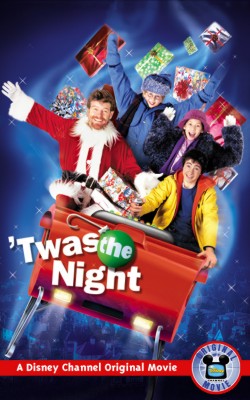
'Twas the Night

Nick Castle, 2001
Rotten Tomatoes score: N/A

Yet again I have to substitute audience reviews for a proper Rotten Tomatoes score. Even the audience was harsh on this one; they gave it 38%.

On Christmas Eve, ambiguously North American teenager Danny Wrigley (Josh Zuckerman) realizes that he has waited too long to do any Christmas shopping. Desperate for some cash to make a few last-minute purchases, he begs first his parents (Torri Higginson and Barclay Hope) and then his younger sister (Brenda Grate), who for some reason enjoys reading quantum physics textbooks in her spare time. The only one who comes through for him is his kid brother (Rhys Williams), whom he scams into buying some worthless junk from his room.

Mom and Dad are furious that Danny would take advantage of the boy, comparing him to Dad's good-for-nothing brother, Uncle Nick. Danny idolizes Uncle Nick, but his parents consider him a bad role model.

And now we meet Uncle Nick (Bryan Cranston from Malcolm in the Middle and later Breaking Bad), who is in the midst of a con game gone sour. Two nerds and their hulk-like enforcer have tied Nick to a chair and demanded that he pay back the money he owes them. Ever the trickster, Nick escapes his imprisonment and flees in a Santa costume.

Shortly thereafter, he arrives at his brother's home on Christmas Eve. The kids regard Nick as a welcome surprise guest, but Dad is less pleased: "The Spanish weren't expecting the Inquisition, but that didn't stop Torquemada." (Is this a Monty Python reference, or just a medieval history reference?) Conveniently for the plot, Mom and Dad get called away to the hospital (apparently they're both doctors) to treat an outbreak of "reindeer flu." (Is that similar to swine flu? It sounds kind of serious.)

Before they leave, the parents hustle all the kids to bed, even Danny, who is none too happy about it. Later, Nick sets to work looking for a way to solve his liquidity problem, but his creditors have hacked into his laptop using some sort of program that seems to work like a one-way webcam so they can taunt and threaten him, while also tracking his location. He responds by click-and-dragging a virus icon onto the streaming video window. This disables not only their tracking software but also "every other working computer within 50 miles." I guess it's one of those airborne computer viruses, because it even disables Santa's computer-controlled sleigh.

Santa Claus lands on the roof, startling Danny and Uncle Nick. Time and space within the house come to a standstill, courtesy of Santa's phenomenal cosmic powers, and St. Nick drops down the chimney. Yes, according to this movie, Santa is able to make his deliveries undetected because he carries a little device that can freeze time, and it also causes objects to shrink for good measure. Unfortunately, the gizmo malfunctions and Danny and Uncle Nick catch Kris Kringle in the act. Alarmed, Santa stumbles, bangs his head against the mantle, suffers a severe concussion, and--

No, he doesn't die. Uncle Nick assures us that Santa is just unconscious, so it's nothing at all like The Santa Clause. Once Uncle Nick discovers the remarkable powers of Santa's gizmos and gadgets, he decides that he and Danny should take over for Santa for the rest of the night. Nick, of course, hopes to turn this into some kind of scam, which Scott Calvin from The Santa Clause would never have done, so you know it's different.

The ersatz Clauses begin their mission, with Uncle Nick snagging a few valuables from each house they hit. He starts with a silver candlestick--what an old-school crook. Danny discovers that Santa's computer lists him as "naughty", and in one of the movie's genuinely funny jokes, he wonders if this is why he got a "Best of 70s Disco" CD for Christmas last year. Nick persuades Danny that Santa is an unfair grouch, and that they should take advantage of their position to do things their way.

Meanwhile, Santa comes to when the brother and sister rouse him, and he panics on the realization that Uncle Nick has jacked his sleigh. For some reason, solving this problem will require them to go to a computer store, which conveniently is open in the middle of the night on Christmas Eve. One of the stupidest moments in the movie occurs when Santa gets jumped, en route, by a street gang and manages to defeat them by tickling them aggressively.

Uncle Nick persuades Danny that they should stop off at a high-society banquet, ostensibly to Robin-Hood the feast and give it to the homeless. In reality, Nick just wants to pilfer the guests' jewelry. Danny catches him in the act and insists that they return home to hand the sleigh off to the real Santa. Nick pockets the magic device and runs off on his own, while Danny flies the sleigh home. The sister attempts to fix the sleigh's damaged control system--apparently her quantum physics book had a chapter on computer maintenance--but she fails.

While plotting his next move, Uncle Nick learns that the three crooks from before are in town and heading for the Wrigley house. Santa tries to defend the household with his moronic tickle-fu, but his Jedi mind tricks don't work on these guys; only money. Luckily, Uncle Nick shows up and uses the shrinking device to intimidate the villains into leaving.

Uncle Nick does his second good deed in life by donating his laptop to be Santa's new onboard computer. Santa mutters something about reconsidering his black and white conception of morality and flies off to return Nick's stolen merchandise and finish his Christmas deliveries. The next morning, Uncle Nick discovers that Santa has left him a present, having decided that Uncle Nick isn't so irredeemable after all.

So everything is back to normal. Uncle Nick only took Santa's job for one night and now he's back to normal, so this is nothing whatsoever like The Santa Clause.


I'm not sure what to say about this one. It's okay. Bryan Cranston gives a decent performance, and it's easy enough to sit through. It's definitely not a good movie, and I think I may have detected a very slight similarity to some other Christmas movie, but I can't put my finger on it. Anyway, 38% seems too low, so this movie is just a little bit


1. Not even an inveterate con man is completely beyond saving.
When you least expect it, he may have a totally unmotivated change of heart.

2. When you take over for Santa Claus, it's okay to do it just once, rather than transforming into the new Santa Claus.
I'm not sure how relevant this will be for most people, but there it is.